
Tea, Trade and the Opium Wars
Tea is often associated with a comforting four o’clock ritual and genteel good manners. Yet the history of Britain's favourite drink contains a much darker chapter.
By the 18th century, tea had become enormously popular in Britain. Demand continued to grow throughout the century, and by the early 19th century millions of pounds of tea were being imported each year. The problem was that Britain imported vast quantities of Chinese tea, while China wasn’t terribly interested in any manufactured goods the British had to offer.
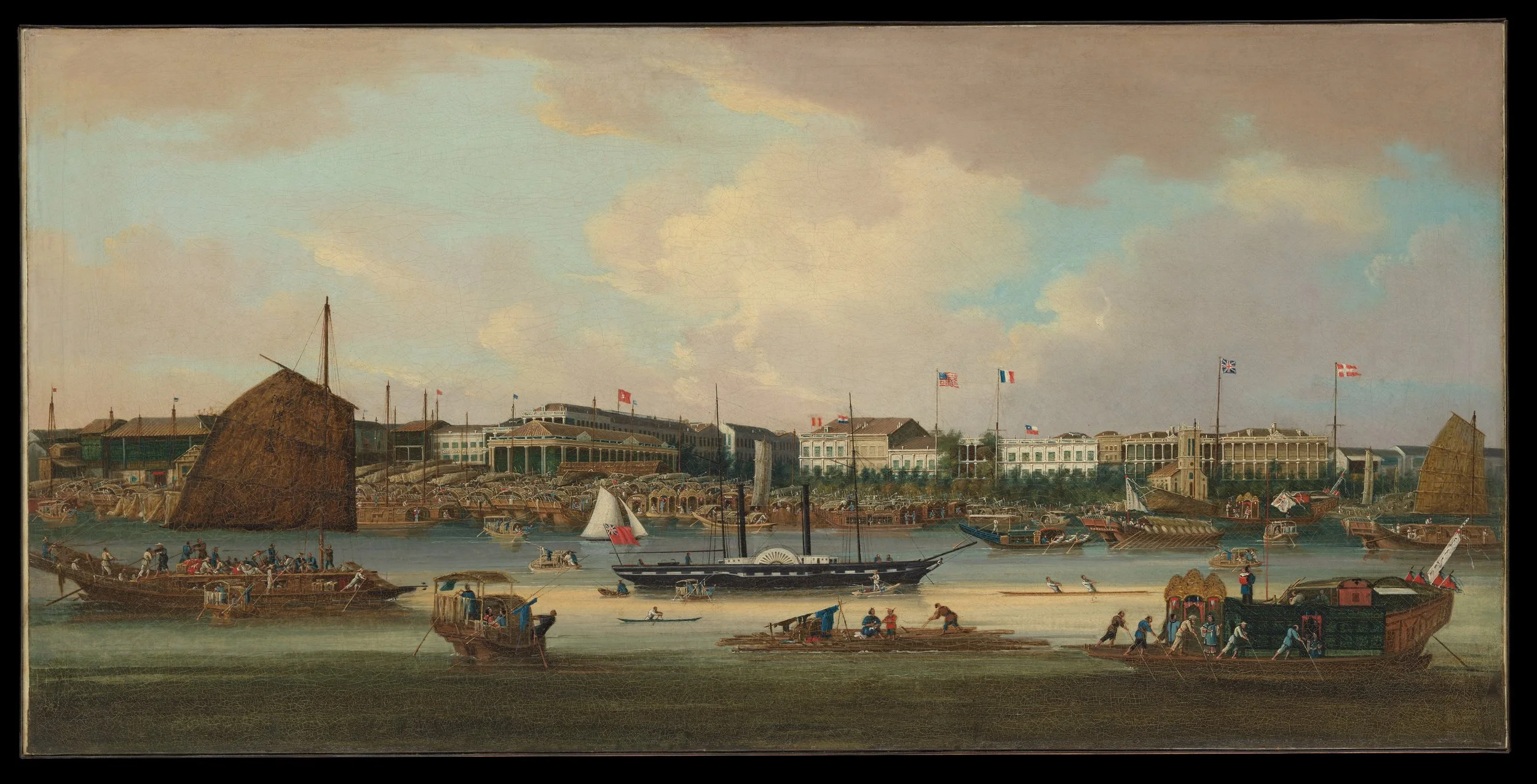
The waterfront of Canton 1847-56, Metropolitan Museum open access
The Tea Trade Imbalance
For many years, tea reached Britain through the East India Company. Ships returned from China laden with tea, porcelain and silk, all highly sought-after products. The Chinese, however, largely preferred silver.
As Britain’s appetite for tea increased, the East India Company and private merchants moved large quantities of silver into China to pay for tea and other Chinese goods. This persistent trade deficit became a growing concern for the East India Company, merchants and politicians, all of whom sought ways to rebalance the trade.
Tea wasn’t the only commodity involved, but it was by far the most important import and helped shape the economic relationship between Britain and China.
Opium and Trade
One response to the trade imbalance was the expansion of the opium trade.
The East India Company oversaw opium production in India, while private merchants transported the drug to China, where it was officially prohibited but widely consumed. Opium was exchanged for silver, which could then be used to purchase tea and other Chinese goods.
For commercial interests involved in the trade, the system proved highly profitable. For China, however, the social consequences became increasingly severe as addiction spread and silver flowed out of the country.
By the 1830s, growing numbers of Chinese officials argued that stronger action was needed. What had begun as a means of addressing a trade imbalance had become a major political and social issue.
China's Response
In 1839, the imperial commissioner Lin Zexu launched a determined crackdown on the opium trade. Large quantities of opium were seized and destroyed at Canton (modern-day Guangzhou) in an attempt to halt the illegal traffic.
The British government responded by sending military forces to protect what it regarded as British commercial and imperial interests. The result was the First Opium War, which ended with the Treaty of Nanking in 1842. Britain's victory forced China to accept a new trading relationship and cede Hong Kong.
A second conflict followed in the 1850s, contributing to a wider system of unequal treaties that expanded foreign commercial access to China.
What Has Tea Got to Do With It?
Tea did not cause the Opium Wars on its own. The conflicts had many causes, and tea was only one part of a much larger story.
Nevertheless, Britain's demand for Chinese tea helped create the trade imbalance that merchants sought to address through opium exports. Tea was therefore not the sole cause of the Opium Wars, but it was closely connected to the trading system from which the conflict emerged.
The Opium Wars remind us that the history of tea extends far beyond the teacup.
Want to discover more of London's tea story? Explore the Tea Trail and uncover the people, places and hidden histories behind Britain's favourite drink.
Part of the Tea Trail Series
Continue exploring London's fascinating tea history: